The complete playbook — from finding the right companies, to cold mailing founders, cracking interviews, and building your resume. No campus placements. No referrals. No portal fees.
Here's exactly how the process works — from zero to offer letter. Follow these steps in order.
Click any step to expand details
Hunt for startups with recent Seed–Series B funding or new product verticals. Less bureaucracy, accessible founders, and open roles.
Avoid applying to Google, Zomato, Swiggy as a fresher — they get 50,000+ applications. Your edge is in the 30–200 person company that just raised.
Where to find them:
Target 20 companies per week. Build a spreadsheet: Company | Founder Name | LinkedIn | Funding Stage | Email (TBD) | Status.
Use ContactOut or Apollo.ai Chrome extensions to extract verified work emails directly from LinkedIn profiles.
The goal is to reach the decision-maker, not the HR inbox. For companies under 50 people, email the Founder or Co-Founder. For 50–200, email the Head of Engineering / Product / Design.
Your cold mail has one job: get a reply. Under 180 words, hyper-personalized, ends with a low-friction ask.
The difference between 0% and 15% reply rate is specificity. Generic openers get deleted. A mail that names their product, spots a real gap, and proposes a concrete fix gets a reply.
Three rounds: HR culture fit → Technical deep-dive with HoD → Final HR + salary. Knowing the flow means you never get blindsided.
Most startup internship pipelines follow this exact structure. The timeline from first reply to offer letter is typically 2–3 weeks.
Use the AI resume builder below. Generates LaTeX code → paste into Overleaf → compile → PDF in 2 minutes.
Recruiters spend 6–8 seconds on your resume. It needs to be clean, scannable, and honest. LaTeX gives you pixel-perfect formatting that Word cannot match.
The secret is targeting companies in the right growth phase. Freshers get noticed at startups that are scaling — not at MNCs processing 10,000 applications.
Series A–B startups in the last 6 months. New funding means new engineering hires, new product features, and founders who are reachable and building fast.
Companies expanding to new geographies or products. They need fast-moving interns who can ship. Founders are hands-on and accessible.
YC-backed and research-to-product companies. If you have relevant project experience, your cold mail will stand out dramatically.
Pre-product-market-fit startups building consumer apps in health, finance, or edtech. The founders still answer emails and hire interns they personally like.
Startups transitioning from SMB to enterprise customers. They need product, engineering, and growth interns immediately.
LLM wrappers, developer tools, and AI-native startups. These teams are tiny and desperately need technically strong students who understand the AI landscape.
site:linkedin.com/company + "Series A" + "hiring".
Or use Inc42's funding tracker to get a fresh list every week. Target 20 companies per week.
The most important step. You need the decision-maker's direct email — not the generic info@company.com black hole.
Your cold mail is your first impression. Under 180 words, hyper-personalized, and end with a clear ask. Here's the exact anatomy:
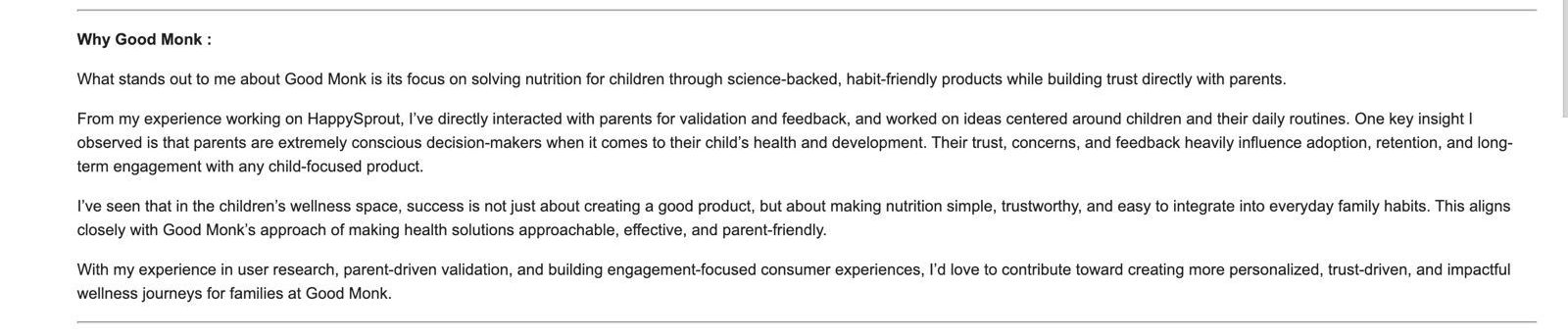
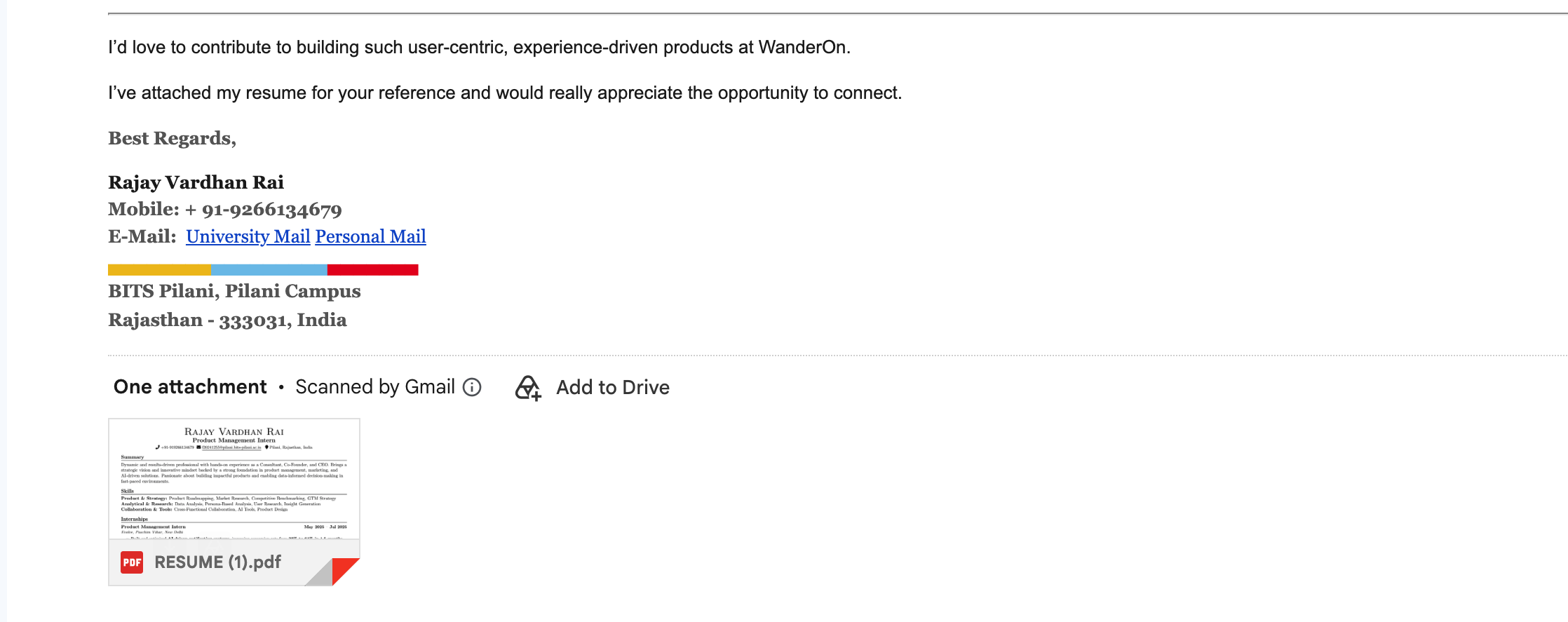
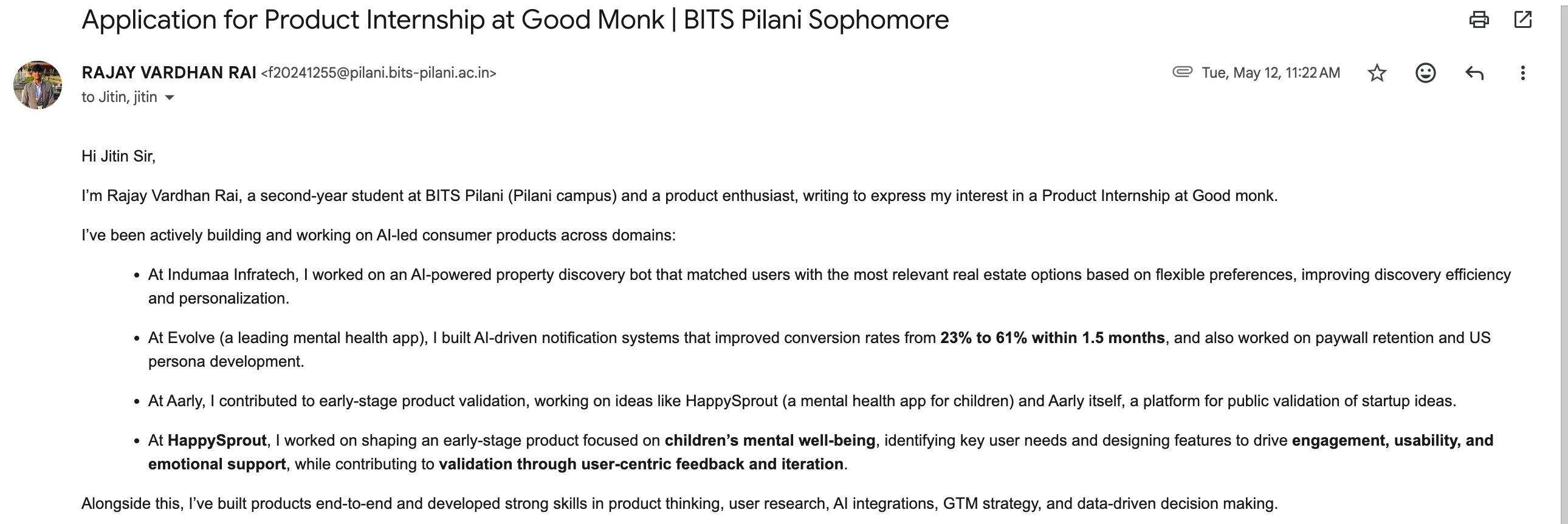
These are Rajay's actual application screenshots sent to Good Monk (children's nutrition startup). Study the structure — 3 scrolls, one ask, real results.
Hi Aman, I'm Rahul — a second-year CS student at BITS Pilani (Goa). I came across FinTechCo after your Series A announcement last month and spent a few hours with your product.
Your UPI reconciliation dashboard is genuinely the cleanest I've seen — but I noticed the analytics tab doesn't surface merchant-level churn signals in real time. Given that you're targeting 10,000+ merchants, that's probably a gap your team already knows about.
I've spent the last semester building a real-time event pipeline in Go + Kafka for a personal project — the same stack your job posts mention. I'd love to spend a summer putting that to work on something that matters.
I put together a rough 2-page spec on how I'd approach the merchant churn signal feature — using event sourcing on the existing transaction stream. Happy to share it if it's interesting. Not asking you to read a thesis — just a concrete demonstration that I can think in your problem space.
Would a 20-minute call next week work? If not, I'm happy to just send the spec over — no call needed. Either way, no pressure.
Best, Rahul
BITS Pilani | CS '27 | github.com/rahul | +91 98765 43210
Never say: "I am a passionate learner who wants to gain experience at your esteemed organization." This goes straight to trash.
Always mention: A specific product, feature, blog post, or funding news. Prove you spent 20 minutes on their product before emailing.
Attach a spec/doc: Spending 2 hours on a concrete proposal beats 20 generic applications. Founders remember effort.
Follow up once: If no reply in 5 days, send one short follow-up: "Following up on my email — still happy to share the spec if useful."
Fill in your details — get a personalised draft like Rajay's in seconds. Tweak, copy, send.
Once you get a reply, here's exactly how the process unfolds — typically 2–3 weeks from first reply to offer letter.
Click any stage to see exactly what happens
Day 1
Day 2–5
Day 6–10
Day 12–16
Day 18–22
Fill in your details below. Claude will generate a complete, recruiter-ready LaTeX resume you can paste into Overleaf and download as PDF in seconds.
Fill in your details and click Generate — your LaTeX resume code will appear here instantly.
Copy the code → paste into Overleaf → compile → download PDF